
Medical Review Officer (MRO) Explained: How DOT Drug Test Results Get Verified
When a DOT drug test comes back non-negative, the verification process can feel opaque for HR teams trying to move quickly and stay compliant.
At AZC Drug Testing, Dr. Scott Krasner is the physician behind that verification step. He has served as AZC’s Medical Review Officer (MRO) for over 30 years and has been a certified MRO for approximately 35 years. Dr. Krasner graduated from medical school in 1983, completed residencies in obstetrics/gynecology and occupational medicine, and now operates Krasner Medical Consultants.
Regulatory language defines the rules. Dr. Krasner’s judgment and hands-on experience make the difference in day-to-day MRO work. Here is what employers and donors should know about how verification happens under 49 CFR Part 40.
What an MRO Actually Does (and Why It Matters)
Under 49 CFR Part 40, an MRO is a licensed physician who receives and reviews laboratory results from an employer’s drug testing program. The MRO also evaluates medical explanations for certain drug-test results.
In practice, this means more than reading a lab report. The MRO reviews non-negative results (positives, refusals, and invalid tests) and evaluates whether a legitimate medical explanation applies. For DOT-regulated programs, the stakes are high. The right outcome depends on an accurate physician review, not just on the initial laboratory screening result.
The Specimen Validity Step: Checking Whether the Urine Makes Sense
Before the MRO evaluates a medical explanation, there is a quality gate inside the testing process itself: urine specimen validity testing.
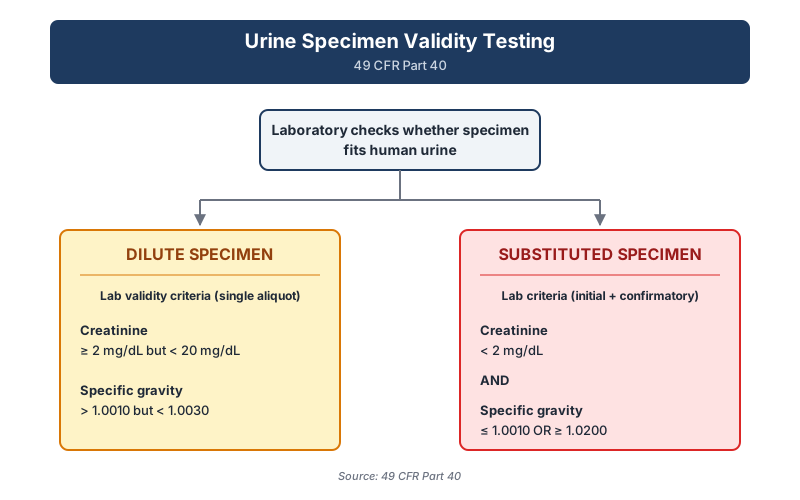
Under 49 CFR Part 40, urine specimen validity testing checks whether the specimen fits human urine. This helps detect adulteration, dilution, or substitution.
Two validity categories employers commonly hear about are dilute specimens and substituted specimens.
Dilute specimen laboratory validity criteria
Under 49 CFR Part 40, a dilute specimen (single aliquot) meets the following laboratory validity criteria:
- Creatinine ≥ 2 mg/dL but < 20 mg/dL
- Specific gravity > 1.0010 but < 1.0030
Substituted specimen laboratory validity criteria
Under 49 CFR Part 40, a substituted specimen meets the following laboratory validity criteria (based on both initial and confirmatory tests):
- Creatinine < 2 mg/dL, and specific gravity ≤ 1.0010 OR ≥ 1.0200
These validity determinations help ensure that the program responds appropriately when results are affected by specimen conditions, not just by the presence of medication.
The Review Rules That Protect Accuracy: 49 CFR 40.127 and 40.129

The MRO role is trusted in part because the regulation defines exactly what must happen during review.
Under 49 CFR 40.129, the MRO must personally review all laboratory-confirmed non-negative results, including positives, adulterated and substituted specimens, and invalid results. Staff working under the MRO’s direct, personal supervision may handle negative results, but an accuracy safeguard still applies.
That safeguard sits in 49 CFR 40.127(g)(2). The MRO must personally review at least 5% of all chain-of-custody forms their staff reviewed each quarter, including every result that required a corrective action. The MRO need not review more than 500 negative results per quarter.
For HR managers, this is a key operational detail. The process is not “set and forget.” A structured mechanism maintains reliable negative determinations while ensuring that non-negative findings receive direct physician review.
What Employers Should Expect After a Non-Negative Result
For employers, the biggest practical question is: “What happens next?”
The answer is straightforward in principle:
- The laboratory reports a result.
- The MRO evaluates it under the Part 40 framework.
- Where applicable, the MRO seeks a medical explanation from the donor.
Dr. Krasner’s approach reflects long experience in occupational medicine and MRO work. He is board-certified in occupational medicine, a Fellow of the American College of Occupational Environmental Medicine, and a Certified Independent Medical Examiner. Those qualifications support one of the MRO’s most important real-world tasks: communication that keeps donors on track so legitimate explanations can be considered.
Practical Donor Advice: Write It Down and Answer the Phone
MRO review often turns on a simple bottleneck: whether the donor can be reached.
Dr. Krasner’s practical advice is designed to prevent avoidable errors and delays.
1. Write down your prescription medications before the test
If you are a donor who has taken prescription medications, Dr. Krasner recommends writing them down before your test.
2. Answer your phone if the MRO calls from an unfamiliar number
If you receive a call from an unfamiliar number after a non-negative result, answer it. Dr. Krasner notes that the MRO may be attempting to reach you.
Why this matters
If a donor cannot be reached, their result may be reported as positive by default, even if a valid prescription exists. The key point for employers is that this outcome can often be revised later if documentation is provided.
In other words, donor availability affects the initial reporting timeline. The MRO still has a pathway to resolve valid medical documentation after the fact.
Why AZC Drug Testing Puts the Right Person at the Center
Regulations outline the “what.” Experience and operational execution determine the “how.”
AZC Drug Testing provides DOT compliance programs covering FMCSA, FAA, FTA, FRA, PHMSA, and USCG. The company supports drug and alcohol testing across DOT program types, including pre-employment, random, post-accident, reasonable suspicion, and return-to-duty. Test types include urine, hair, breath alcohol, and oral fluid.
AZC provides access to a national network of 10,000+ testing sites, a practical advantage when you need testing availability that matches real operational schedules.
For many HR teams, the most reassuring factor is who performs the physician review.
Dr. Krasner, AZC’s MRO, has been certified for approximately 35 years and has served in the role for over 30 years at AZC. He operates Krasner Medical Consultants and serves as a clinical associate professor at the University of Arizona College of Medicine.
That combination of MRO certification tenure, occupational medicine expertise, and a long-standing AZC relationship means employers work with a clinician who understands both the compliance requirements and the human realities of getting donors through the process.
Conclusion: Verification Is a Process, Not Just a Report
In DOT drug testing, accuracy depends on the full chain: validity testing, structured MRO review, and donor communication when medical explanations may apply.
Under 49 CFR 40.129, the MRO personally reviews non-negative results. Under 49 CFR 40.127(g)(2), the MRO personally reviews at least 5% of the chain-of-custody forms handled by their staff each quarter. Specimen validity testing applies laboratory criteria for dilute and substituted specimens, helping identify problems tied to specimen conditions.
Small actions matter in practice. Writing down prescription medications and answering the phone after non-negative outcomes can help prevent avoidable default reporting.
Want a quick reference for what your DOT program needs? Download the free DOT Compliance Checklist.
Schedule your free DOT compliance assessment today.
Frequently Asked Questions
What is a Medical Review Officer (MRO)?
Under 49 CFR Part 40, a Medical Review Officer is a licensed physician who receives and reviews laboratory results from an employer’s drug testing program and evaluates medical explanations for certain non-negative results.
What does an MRO do under 49 CFR Part 40?
Under 49 CFR 40.129, the Medical Review Officer personally reviews all laboratory-confirmed non-negative results, including positives, adulterated and substituted specimens, and invalid results. Under 49 CFR 40.127(g)(2), the MRO must also personally review at least 5 percent of the chain-of-custody forms their staff reviewed each quarter, including every result that required a corrective action.
What happens if I miss the MRO’s call after a DOT drug test?
If the MRO cannot reach the donor, the result may be reported as positive by default, even when a valid prescription exists. This outcome can often be revised later if proper medical documentation is provided.
What is a dilute specimen in DOT drug testing?
Under 49 CFR Part 40, a dilute urine specimen has a creatinine concentration of at least 2 mg/dL but less than 20 mg/dL, and a specific gravity greater than 1.0010 but less than 1.0030.
What is a substituted specimen in DOT drug testing?
A substituted specimen has a creatinine concentration of less than 2 mg/dL and a specific gravity of 1.0010 or lower, or 1.0200 or higher, on both initial and confirmatory tests.